 Posted by
 The latest MIT study didn’t whisper… it shouted.
According to researchers using a new labor-simulation model called the Iceberg Index, AI can already replace 11.7% of the U.S. workforce.
Not “someday.”
Not “when AGI arrives.”
Now.
Nothing in that surprises me… which may surprise you.
That’s about 18 million American jobs where today’s systems can already perform the required tasks as well as (or better than) a human.
And here’s the twist that might surprise you…
The jobs most exposed aren’t the stereotypical “tech” roles.
In fact, tech and computing roles only represent 2.2% of the exposure.
The frontline of disruption isn’t the technical class… it’s the work that sits between complexity and routine.
Finance… healthcare… customer service… administrative work.
Anywhere large swaths of tasks are digital, repeatable and cognitively structured.
Putting the results aside, what MIT built is astonishing.
They didn’t model industries… they modeled individuals.
151 million American workers.
Each represented as an agent tagged with skills, tasks, occupations and event ZIP codes.
32,000 distinct skills… 923 occupations… 3,000 counties.
Then they overlaid AI’s current capabilities onto that labor map.
The output is less science fiction and more of a diagnosis.
And buried inside the MIT findings is a bigger question… not about jobs, but about value.
If AI can already do a measurable percentage of the work…
What is the purpose of human work now?
Which brings us to another headline from this week…
A man credits the X chatbot Grok with saving his life.
After an ER dismissed his symptoms as acid reflux, Grok urged him to go back and demand a CT scan.
Without that advice, his appendix would have ruptured.
So in the same dramatic breath, AI is eliminating jobs and saving humans?
This is the contradiction we must hold.
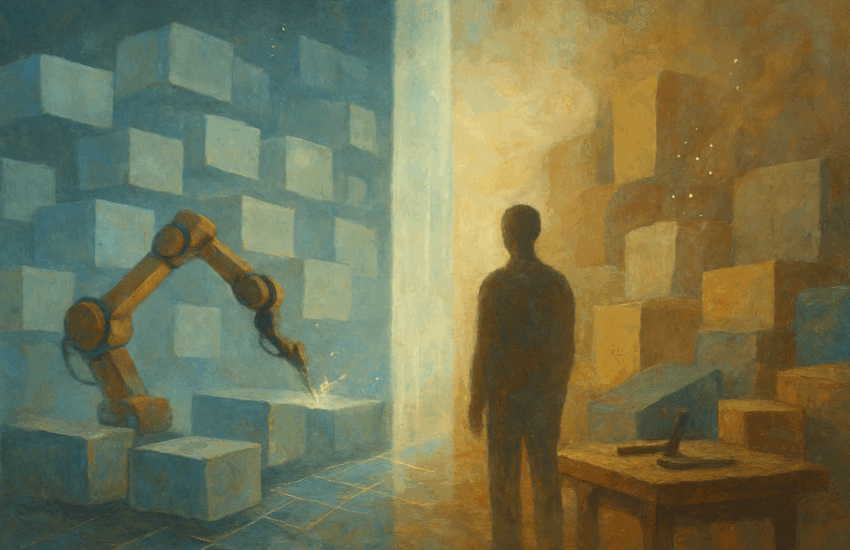
AI is replacing the work we think defines us…
while revealing the work that actually does.
Physical labor, which many thought would be automated first, turns out to be insulated for now.
You cannot outsource plumbing, electrical, carpentry or automotive repair to a transformer model.
The trades are emerging not as “alternatives” but as pillars of resilience, entrepreneurship and opportunity (it’s a highly technical and physical skill to build these data centers, as a reminder).
Meanwhile, the so-called prestige career paths… think doctor, lawyer, accountant… suddenly have the potential to become more accessible, not less.
If AI can handle the rote complexity… the barrier to entry becomes lower.
The scarcity model cracks… the hierarchy softens.
Now start thinking about our education system and where we put the excellence and value.
We spent decades telling people the future demanded technical skills.
MIT is now quietly telling us… the future demands irreplaceability.
The Iceberg Index shows AI penetrating deep into the parts of the economy built on structure, repetition and documentation.
But it also exposes a truth we don’t want to say aloud:
We designed the modern workplace for machines long before the machines arrived.
So now the wrong question is:
“How many jobs will AI eliminate?”
The right question is:
“What kind of work becomes more valuable when intelligence is abundant?”
And suddenly, the answers look surprisingly human…
Work that requires presence.
Work that requires touch.
Work that requires moral judgment.
Work that requires empathy and accountability.
Work where consequences matter more than calculations.
Work where the human interaction adds value and builds brand.
AI may already outperform millions of tasks…
But it still doesn’t take responsibility for outcomes.
It predicts… it advises… it infers.
Then it hands the decision back to someone with real skin in the game.
Which means the leaders, workers and families who thrive in this shift will be the ones who stop asking how to compete with AI… and start asking what only they can do.
Because if 11.7% of jobs can already be automated, the real risk isn’t displacement.
It’s denial.
We can elevate the trades.
We can widen access to the professions.
We can redesign work around what humans are uniquely equipped to deliver.
But if we don’t… we’ll be living in a labor market shaped by AI’s strengths instead of our own.
And that’s not a future anyone should outsource.
This is what Elias Makos and I discussed on CJAD 800 AM.
Before you go… ThinkersOne is a new way for organizations to buy bite-sized and personalized thought leadership video content (live and recorded) from the best Thinkers in the world. If you’re looking to add excitement and big smarts to your meetings, corporate events, company off-sites, “lunch & learns” and beyond, check it out.
 Never another podcast episode or article