 Posted by
 I don’t think the AI conversation is really about AI anymore.
At least not the part that keeps getting sold to us. The big story is abundance. A future where artificial intelligence becomes so powerful, so efficient and so embedded into everything that life gets easier for everyone. Work changes… productivity explodes… costs collapse. Maybe universal basic income shows up… maybe universal super income. Maybe we all live in some strange digital renaissance where machines handle the grind and humans finally get back to being… human.
It’s a beautiful story… I want to believe it (big Star Trek fan right here).
But then you look at what is actually happening inside the companies building this future… and the story gets… well… it’s complicated. Let’s use the last few weeks of news out of Meta as a useful example here… not because this is about Meta alone, but because Meta has become one of the avatars for the moment.
Here’s what we’ve been told…
- Meta is breaking ground on another massive data center… this time in Tulsa… as part of its reported $600 billion push to build the infrastructure needed for its next stage of AI and “superintelligence.” It is the company’s 28th U.S. data center and 32nd globally… which is another way of saying: the future of AI may feel magical on the screen, but underneath it is concrete, land, power, capital and a very serious race to own the energy behind the GPUs.
- Meta is reportedly experimenting with an AI-powered digital clone of Mark Zuckerberg that employees can interact with… a kind of always-on leadership twin trained to mirror his voice, expressions, phrasing and strategic thinking. It is being framed as a way to make leadership more accessible inside a massive global company… but it also raises a much stranger question: when the CEO can be cloned, is that empowerment, efficiency, or the beginning of leadership becoming another interface?
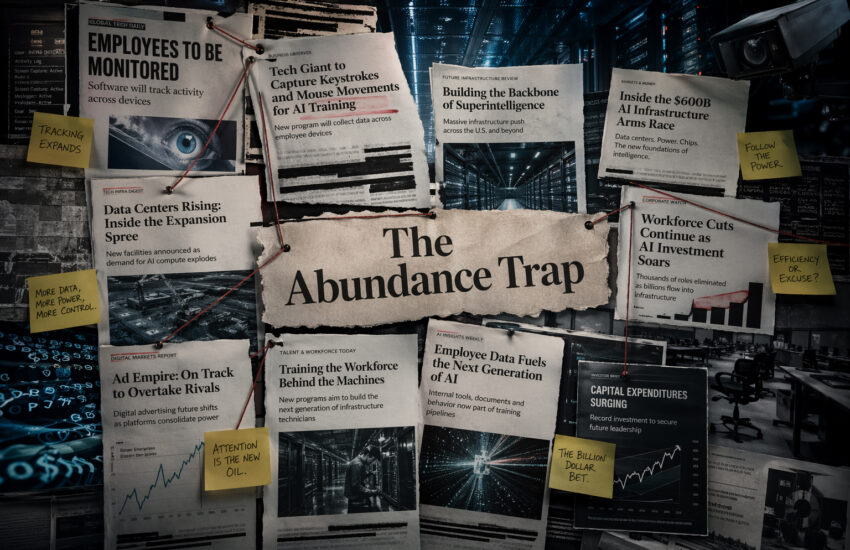
- Meta is reportedly expanding its employee tracking project to capture how staff use popular sites and apps as part of its AI model training efforts. It is being positioned as a way to make Meta’s models more capable… but it also points to a much bigger shift: the everyday habits of knowledge work are becoming fuel for the machines being built to reshape that very work… and it’s hard to believe that this is about education and not surveillance.
- Meta’s last reported quarter showed a company that is still printing money… $59.89 billion in revenue for Q4 2025, up 24%, with net income of $22.77 billion… while also preparing to spend between $115 billion and $135 billion on capital expenditures in 2026, largely to build the AI infrastructure behind its next act.
- Meta will surpass Google in global digital ad revenue by the end of 2026. This isn’t just a company funding an AI future… it may also be becoming the new centre of gravity in digital advertising.
- Meta is reportedly cutting roughly 10% of its workforce… about 8000 people… while also leaving thousands of open roles unfilled. The tension is hard to miss: one side of the company is being reduced in the name of efficiency, while another is being funded at historic levels to build the systems that may redefine who gets to stay inside the future of work.
So… which future story are we supposed to believe?
The one where AI creates abundance for everyone? Or the one where the companies building the abundance are still cutting roles, monitoring workers, compressing teams and turning daily work into training data all while capturing more power (at every level). Reminder: This isn’t a hit piece… it’s a pattern that we can trace. The same organizations promising that AI will unlock new levels of prosperity are often the ones showing us what happens first when intelligence becomes cheaper: surveillance expands, labor gets squeezed, workflows get captured and efficiency becomes the language that makes subtraction sound strategic.
This is the part that matters for anyone thinking about their career right now.
The real question is not whether AI will take your job. That frame is too simple… too binary… too easy to dismiss. The better question is: what part of your work becomes more valuable when execution gets cheaper? Because that is where the career conversation needs to go. If your value is speed, AI will challenge you… If your value is volume, AI will challenge you. If your value is producing the first draft, the summary, the schedule, the report, the presentation, the analysis, the code, the campaign or the output that gets things “good enough,” AI will challenge you.
That’s not someday… that’s now.
We are entering a moment where work itself is becoming training data. Not just the document you create, but how you create it. Not just the output, but the invisible choreography behind the output. The pauses… the clicks… the revisions… the shortcuts… the decisions… the judgment calls. The parts of knowledge work that were never captured on a dashboard… until now.
So how long do we wait for this abundance narrative to start kicking in (and who’s paying for it)?
Do we wait for the technology to mature? Do we wait for companies to redistribute the gains? Do we wait for policy to catch up? Do we wait for the future to become fair? Right now it feels like the people who thrive in this next chapter won’t be the ones who simply “use AI.” The advantage will go to the people who use AI without becoming more generic. The people who can make better decisions, build stronger trust, ask sharper questions, create work that feels less like output and more like perspective… and can build a real brand.
Maybe AI will create abundance… maybe the optimists are right… I hope they are… I’d like to think that I’m one of them…
Before you go… ThinkersOne is a new way for organizations to buy bite-sized and personalized thought leadership video content (live and recorded) from the best Thinkers in the world. If you’re looking to add excitement and big smarts to your meetings, corporate events, company off-sites, “lunch & learns” and beyond, check it out.
 Never another podcast episode or article