 Posted by
 Does AI music suck?
If you found out a song was made with AI, how would you feel about it? Would you listen? Would you care? Many are very passionate about their hate for all things AI… especially when it comes to AI music. I’ve spent the better part of my career in the music business (to one extent or another) and I’m less dramatic about it. Mostly because of how AI also connects with my other work and how often new tools are first dismissed before they become part of the creative process.
I don’t think AI music is really a music problem.
At least not entirely. There’s an abundance problem… and maybe an authenticity problem… wrapped inside a discovery problem… sitting on top of a platform problem. And it’s starting to feel like the fear in this moment is bigger than the songs being generated by prompts. If we look more closely at it, what’s happening to music right now is the same thing that has already happened to text, images, video, product reviews, social feeds and search results. The cost of creation has collapsed. The friction to create something is disappearing. The volume is exploding. And the systems designed to help us find quality inside that tsunami are struggling to keep up.
That’s the real story.
For years, the streaming era sold musicians and listeners on a kind of democratized dream. Distribution was solved. Anyone could upload music. Anyone could reach the world. Anyone could theoretically find an audience (and many did). That felt revolutionary compared to the old gatekeeper era of labels, radio stations and retail shelf space. It wasn’t just music streaming services either, there was a thick cross-pollination with social channels (think TikTok, YouTube and Instagram) that gave artists an unlimited canvas to create, express, publish, market and distribute.
Maybe AI just pushed that logic to its absolute endpoint?
Now anyone can generate a song… or a hundred songs… or a thousand songs. We have “fake” AI-generated artists… synthetic bands… infinite discographies. Music-shaped content generated not because someone had something to say… but because the economics of platforms reward inventory. I think that’s the real rub. Because music (and writing… and more) is not just content…. at least we don’t (always) experience it that way. We experience it emotionally. We attach songs to heartbreak, identity, memory, rebellion, joy, adolescence, road trips, first kisses and funerals. Music becomes part of the scaffolding of our lives. Even when listeners can’t articulate it, there is usually an assumption sitting underneath the experience… that another human being meant this. That someone lived something… felt something… and translated it into sound that made us, as humans, feel something too.
When you think about AI music (or anything AI related, for that matter) that’s the only dividing line that matters.
A human artist using AI as a tool is not the same thing as a spammer generating 100,000 anonymous tracks to siphon royalties or game a system. A producer experimenting with AI-assisted workflows is not the same thing as flooding streaming platforms with synthetic filler music designed to game playlists and algorithms.
The issue is not whether AI touched the music… it’s whether the music actually touches another human’s heart.
And platforms are now stuck trying to figure out how their systems, built to maximize access and engagement, are now vulnerable to infinite scale pollution. These same platforms are reportedly seeing tens of thousands of fully AI-generated tracks uploaded every day and they are also removing millions of spam tracks. We already know that detection systems are imperfect and their recommendation engines get noisier as the flood rises.
The old problem was finding a needle in a haystack… AI is now manufacturing hay.
And this is where the conversation gets culturally interesting. Because when synthetic content becomes abundant, human-made work may become more valuable… not less (this seems to, historically, be the economic trend). Do vinyl records move from nostalgia to become the human signal in response to industrial scale convenience? Does scarcity become trust and/or the human fingerprint behind the work?
AI music isn’t going anywhere.
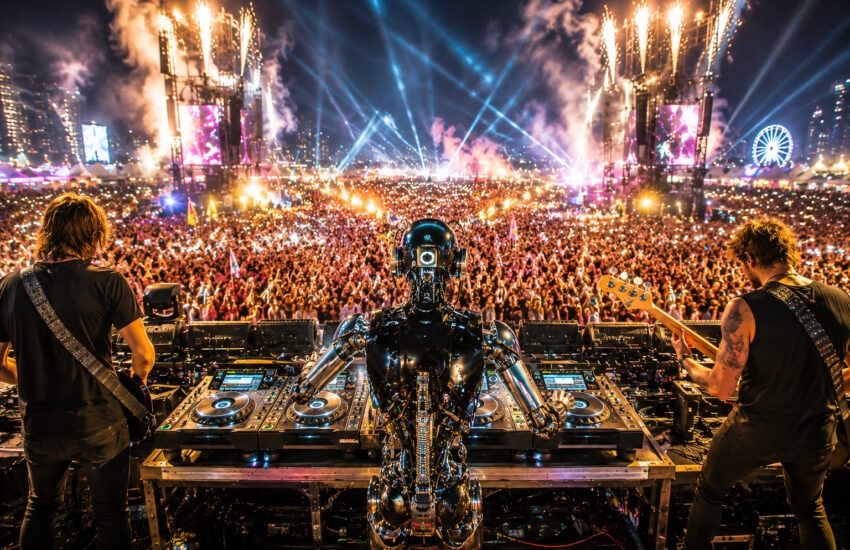
AI will absolutely become part of music production. Songwriters will use it for sketches. Producers will use it for experimentation. Engineers will use it for mastering and workflow optimization. Artists will collaborate with it in ways that are genuinely creative and interesting (the kind of end result they could not have created in a studio)… that’s the good version. The bad version is the bad stuff scales and music stops being expression and becomes inventory. When platforms become AI landfills of synthetic content optimized for engagement instead of meaning. And, as one of “The Olds” who laments the days of wandering around downtown, hopping from record store to record store, learning about new bands and meeting like-minded fans (who became lifelong friends) that’s why the real challenge here is not technological… it’s cultural. The future of music won’t be divided into “AI” versus “human” or have labels identifying it as such. That feels too simplistic. The real divide may, simply, become music that feels like someone meant it… versus music that simply exists because a machine could generate it cheaply (and don’t forget we had that with muzak).
Culture does not need more content… culture always needs more meaning and connection.
This is what Elias Makos and I discussed on CJAD 800 AM.
Before you go… ThinkersOne is a new way for organizations to buy bite-sized and personalized thought leadership video content (live and recorded) from the best Thinkers in the world. If you’re looking to add excitement and big smarts to your meetings, corporate events, company off-sites, “lunch & learns” and beyond, check it out.
 Never another podcast episode or article