 Posted by
The more we know… the better decisions we should make.
Does that land with you? A significant portion of the earlier part of my career was spent in data thirst… if we only had more data, we would be better informed. That quickly changed (thanks, web analytics and digital channels) to working with brands that were drowning in data. It was pouring out of them from every siloed orifice… and they weren’t sure what to do with it. Better customer data… better analytics… better attribution… better dashboards… better insights… better ways to understand what people are actually doing.
But (and bear with me here)… maybe we don’t use data primarily to make better decisions.
Maybe we use it to make ourselves feel better about the decisions we already want to make? That’s what I’ve been thinking about since my conversation with Sebastian Wernicke on this week’s episode of Thinking With Mitch Joel. Sebastian runs a data science and AI team at Oxera and is the author of new book, Data Inspired. Early in our conversation, he brought up research into something most of us know as confirmation bias. People with opposing views were shown the same mixed evidence. Instead of the data bringing them closer together, both groups walked away believing their original position more strongly. We know this… we accept the evidence that supports our instincts and question the evidence that doesn’t… and somehow (and very often) emerge from the experience more certain they had been right all along.
That’s not a data problem… it’s a human problem.
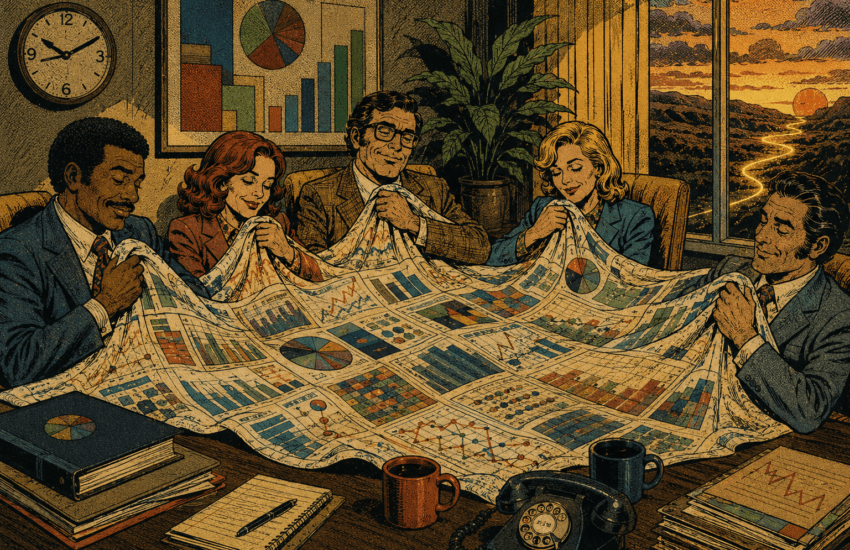
And it gets much more interesting when you move from individuals into organizations. Think about how data often shows up in a business meeting. We have a choice to make… and in come the slides. And they’re lathered up in data goodness from market size and customer research to benchmarks and forecasts. You get everything in every way from text and quotes to charts to competitive analysis. Whatever is needed to support the case. Sebastian said it best: sometimes the purpose of all that data isn’t really insight… it’s comfort. It makes uncertainty feel a little less uncertain.
Maybe businesses aren’t as addicted to data as we think… maybe we’re addicted to certainty and proving our positions…
It’s the oldest business story we know: The future is unknowable… and no business likes uncertainty. Leaders are paid to make decisions without having all of the information… customers behave unpredictably… competitors surprise us… markets are… brutal. There’s more… culture changes and technology arrives and suddenly something that made perfect sense yesterday looks ridiculous today.
The truth? Nobody knows… and that’s the actual job.
But say the words “I don’t know” in a boardroom and watch how quickly you’re updating your LinkedIn profile. So we build dashboards (err… stories)… and now we have AI. Which should make this better… right?… maybe? AI gives us an extraordinary ability to interrogate information… analyze massive amounts of unstructured data… generate semi-decent scenarios… find patterns… ask better questions. Do in minutes what might previously have taken a team weeks.
I’m all in on that.
But… what happens when you give a confirmation-biased species an infinitely patient machine capable of helping it find reasons why it might already be right? Have you ever taken the result from a generative AI engine and asked it to give you both a positive and a negative review (and then do the same thing on it’s on content)? If you haven’t… I’d recommend it. You can keep going until the answer starts looking like the answer you wanted. That’s the part I find fascinating. AI doesn’t just give us more information… it removes the friction required to find an argument that agrees with us. We used to have limited data and unlimited opinions. Now we may be heading toward unlimited data and unlimited opinions. But we don’t know if it creates better decisions… especially if we’re secretly using it to make ourselves more certain. Will one of the most important leadership skills in this AI era be developing the psychological ability to ask…
What would I need to see to change my mind?
Suddenly, we’re using information not as insurance against uncertainty… but as an invitation into it. Looking for the inconvenient truth… the outlier… the evidence that threatens the strategy instead of validating it. Sebastian calls this becoming “data inspired” instead of simply “data driven.” The end goal may not be having enough data to drown judgement but enough curiosity that the data can still surprise us.
Especially when we’re absolutely certain we’re right.
Before you go… ThinkersOne is a new way for organizations to buy bite-sized and personalized thought leadership video content (live and recorded) from the best Thinkers in the world. If you’re looking to add excitement and big smarts to your meetings, corporate events, company off-sites, “lunch & learns” and beyond, check it out.
 Never another podcast episode or article