 Posted by
 Episode #1057 of Thinking With Mitch Joel is now live.
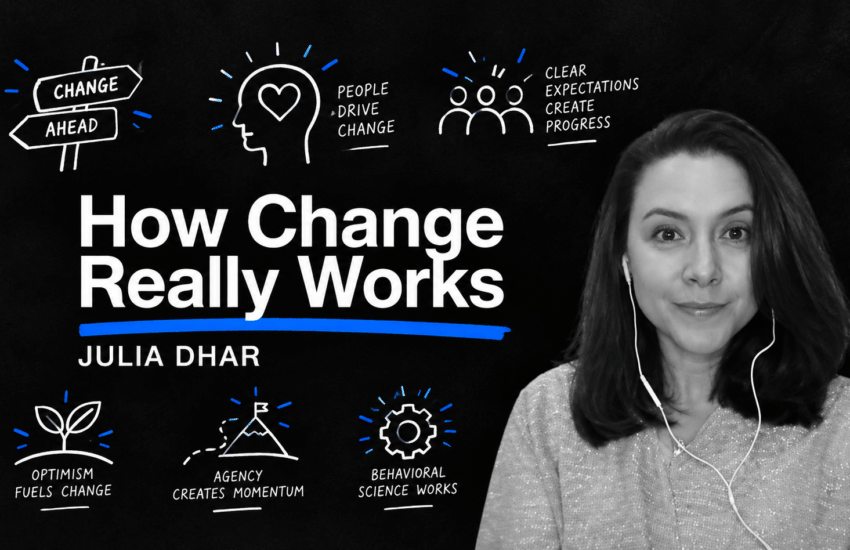
This conversation with Julia Dhar gets into one of the most frustrating realities in business: organizations keep investing extraordinary amounts of money, time and human potential into transformation… and most of those efforts still fail. Julia has spent much of her career trying to understand why. She is a leading voice in behavioral science and organizational transformation, the founder of the Behavioral Science Lab at Boston Consulting Group, a three-time World Schools Debating Champion and a TED speaker known for her work on productive disagreement.
Her new book, How Change Really Works – Seven Science-Based Principles For Transforming Your Organization (co-authored with Kristy R. Ellmer and Philip Jameson) challenges one of the most convenient myths leaders tell themselves: that people are naturally resistant to change.
Julia makes a very different argument. People do not necessarily resist change. They resist change that does not make sense to them. They resist change that ignores their lived reality. They resist change when they are asked to participate in something without optimism, without clear expectations and without any real sense of agency. That matters now more than ever. AI is forcing almost every organization into some version of transformation. Leaders are under pressure from boards. Employees are trying to figure out whether these tools will help them, replace them, dull their thinking or simply create more work slop. Everyone knows change is happening. Far fewer people understand what they are being asked to become. In this conversation, Julia and I talk about why so many transformations fail, what AI reveals about the disconnect between executives and employees, and why simply announcing a new strategy is not the same as creating true agreement. We get into change distance, the gap between leadership enthusiasm and employee reality, and why optimism, agency, clear expectations and collective confidence are essential if change is going to stick. We also talk about storytelling, symbols, productive disagreement, feedback, the danger of homogeneous AI-generated thinking and why organizations often confuse involvement with empowerment. Mostly, this is a conversation about the human psychology of transformation. Strategy may set the direction, but people decide whether change becomes real.
Listen to my conversation with Julia Dhar here: How Change Really Works With Julia Dhar – TWMJ #1057.
Before you go… ThinkersOne is a new way for organizations to buy bite-sized and personalized thought leadership video content (live and recorded) from the best Thinkers in the world. If you’re looking to add excitement and big smarts to your meetings, corporate events, company off-sites, “lunch & learns” and beyond, check it out.
 Never another podcast episode or article