 Posted by
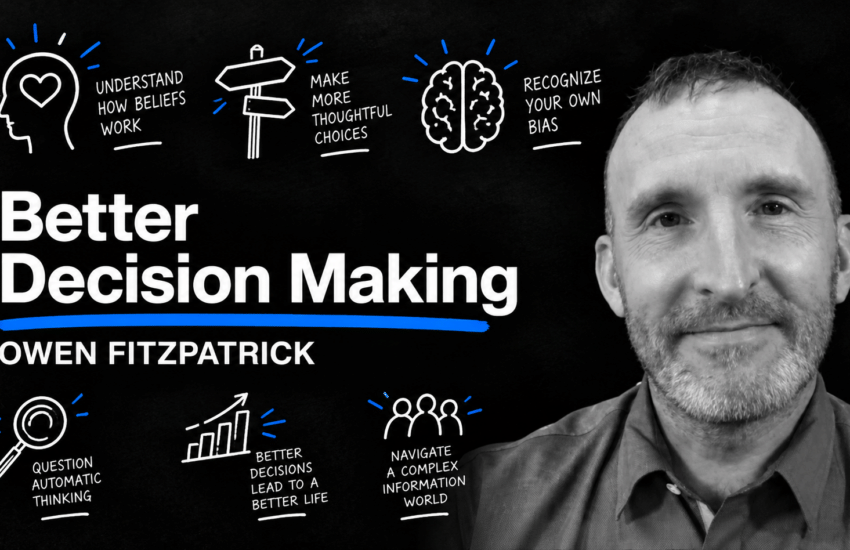
Episode #1059 of Thinking With Mitch Joel is now live.
We spend so much time worrying about the propaganda being pushed at us by politicians, the media, social networks and increasingly sophisticated technologies. We question the motives, challenge the messaging and wonder how other people can possibly believe some of the things they believe. But what happens when the most convincing propaganda isn’t coming from somewhere else… it’s coming from inside our own heads? That’s the fascinating premise behind my conversation with Owen Fitzpatrick, a psychologist, author and expert in influence, persuasion and belief formation. Owen has spent decades studying how people think, what they believe and how those beliefs can be changed. His work has taken him to more than 30 countries, including North Korea and Afghanistan, where he explored the mechanisms of propaganda and persuasion.
His new book, Inner Propaganda, brings that research into a much more personal space.
Owen argues that our brains are constantly constructing narratives, selecting evidence and convincing us that what we feel must be true. The more intelligent we are, the more sophisticated we may become at defending those beliefs. This isn’t simply about cognitive biases or negative self-talk. It’s about recognizing how easily we mistake our interpretation of reality for reality itself. In this conversation, we explore why certainty can be so seductive, why our minds gravitate toward extreme positions and simple explanations, and how the modern attention economy exploits those tendencies. We talk about the difference between critical thinking and nuanced thinking, the discomfort of changing our minds, and why understanding someone else’s beliefs requires more curiosity than judgment. We also get into something especially relevant for leaders. Owen introduces his framework of “Feels Right, Fits In, Makes Sense,” explaining why presenting facts and a logical strategy rarely creates genuine commitment. People need to connect emotionally with an idea and see how it fits their identity before the reasoning can take hold.
What makes this conversation particularly compelling is the tension between conviction and intellectual humility.
We need beliefs to navigate the world, but those same beliefs can prevent us from seeing it clearly. Perhaps better decision making begins with a willingness to question not just what we’re being told… but what we’ve already convinced ourselves is true.
Listen to my conversation with Owen here: Better Decision Making With Owen Fitzpatrick – TWMJ #1059.
Before you go… ThinkersOne is a new way for organizations to buy bite-sized and personalized thought leadership video content (live and recorded) from the best Thinkers in the world. If you’re looking to add excitement and big smarts to your meetings, corporate events, company off-sites, “lunch & learns” and beyond, check it out.
 Never another podcast episode or article